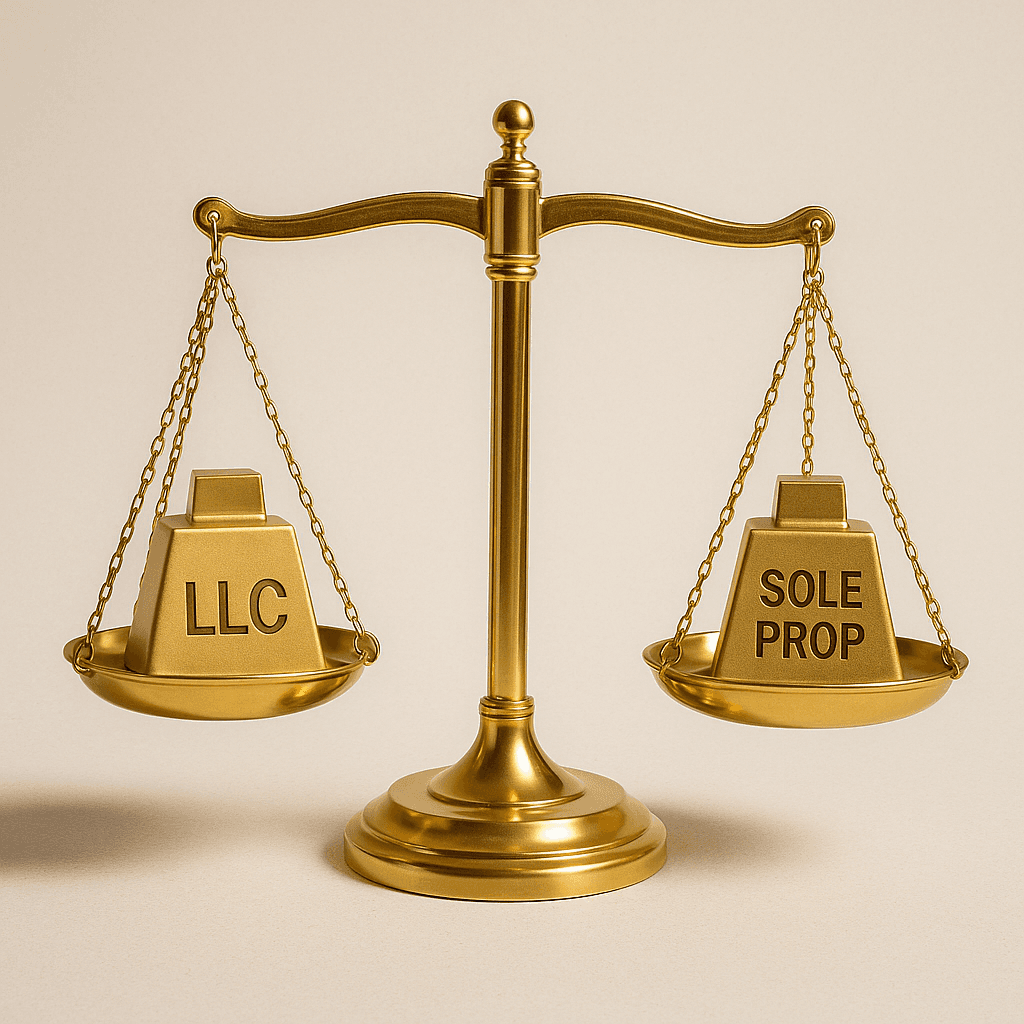
Sole Proprietorship vs. LLC: Which Business Structure Is Right for You?
By Garrett Clark
What Is a Sole Proprietorship?
A sole proprietorship is the simplest and most common type of business structure for solo owners. It's not a legal entity in itself, but rather an extension of you as an individual. You and your business are legally the same.
How It Works:
No formal registration required (in most states)
You operate under your name or a DBA (“Doing Business As”)
You report business income and expenses on your tax return
Typical Users:
Freelancers
Independent contractors
Side hustlers
Online sellers
Service providers are just getting started
What Is an LLC?
An LLC (Limited Liability Company) is a legal entity that is separate from its owner. While it still offers pass-through taxation like a sole proprietorship, it provides personal asset protection and greater flexibility.
How It Works:
You register your LLC with the state
It can own property, enter into contracts, and be sued independently of you
You can operate under the LLC name
Taxes can be reported as a sole proprietorship or elected to be treated as an S Corporation
Typical Users:
Solo business owners ready to protect their assets
Freelancers earning consistent income
Coaches, consultants, creatives, and ecommerce sellers
Business owners planning for growth
Key Differences Between Sole Proprietorship and LLC
Let’s break this down by the most important factors:
Sole Proprietorship:
You’re personally liable for all business debts, lawsuits, and obligations. If your business gets sued or owes money, your assets (house, car, savings) are at risk.
LLC:
Your assets are legally separate from your business. This means creditors or lawsuits typically can’t go after your personal property to satisfy business obligations.
Advantage: LLC
Sole Proprietorship:
Easy and free to start. You can begin operating as soon as you earn money, and many states don’t require any formal registration unless you want a business license or DBA.
LLC:
You need to file Articles of Organization, pay a state fee (usually $50–$500), and comply with ongoing requirements like annual reports or fees.
Advantage: Sole Proprietorship
Sole Proprietorship:
You file income and expenses on Schedule C of your tax return. You also pay self-employment tax (Social Security and Medicare) on all profits.
LLC:
By default, taxes work the same as a sole proprietorship. However, you can elect S Corp taxation, which may reduce self-employment tax by allowing you to pay yourself a salary and take additional profits as distributions (which are not subject to self-employment tax).
Advantage: LLC (more tax flexibility, especially as income grows)
Sole Proprietorship:
You operate under your name unless you file a DBA. While that’s fine early on, it may not seem as professional to clients, lenders, or vendors.
LLC:
Having “LLC” after your business name gives your operation a more official and credible presence. This can be a major advantage when working with higher-end clients, applying for business credit, or establishing vendor relationships.
Advantage: LLC
"Choosing the right business structure isn’t just a legal step - it’s a foundation for your future. Whether you’re starting small or scaling fast, the right choice between a sole proprietorship and an LLC can protect your assets, boost your credibility, and unlock long-term financial growth."
Garrett Clark
Director of Sales
Sole Proprietorship:
You can open a business bank account, but many lenders and investors prefer businesses with formal legal structures. Mixing personal and business funds is common - and risky.
LLC:
You’re encouraged (and sometimes required) to open a separate business bank account. This simplifies bookkeeping, improves financial discipline, and helps you build business credit.
Advantage: LLC
Sole Proprietorship:
Minimal paperwork. No annual filings (in most states). No need for operating agreements or business formalities.
LLC:
Somewhat more upkeep. You’ll likely need to file annual reports, pay renewal fees, and maintain an operating agreement - even if you’re the only owner.
Advantage: Sole Proprietorship
Sole Proprietorship:
Not designed to grow beyond the owner. If you want to add partners, sell your business, or bring in investors, you’ll likely need to restructure.
LLC:
Built to scale. You can add members, raise capital, or even convert into a corporation if your business expands significantly.
Advantage: LLC
Which One Should You Choose?
Choose a Sole Proprietorship if:
You're just testing the waters or side hustling
You want to avoid upfront costs and paperwork
Your business has little to no liability risk
You're not earning much yet (under $10K–$20K per year)
You’re comfortable with personal liability
Choose an LLC if:
You want to protect your assets
You're earning consistent income or planning to scale
You want to appear more professional and credible
You’re ready to separate personal and business finances
You want flexibility in how you're taxed (especially S Corp)
How an LLC Pairs with a Solo 401(k)
If you’re serious about maximizing your business income and building long-term wealth, an LLC also allows you to open a Solo 401(k). This retirement plan is designed specifically for self-employed individuals and offers:
Higher contribution limits (up to $69,000 in 2025)
Major tax savings through pre-tax or Roth options
Investment flexibility - including real estate, gold, crypto, and more
Checkbook control, when set up properly
Operating your business through an LLC and pairing it with a Solo 401(k) is one of the smartest financial moves a solo entrepreneur can make.
Your Business, Your Terms
There’s no one-size-fits-all answer - but understanding the trade-offs between a sole proprietorship and an LLC empowers you to make the best decision for your goals, budget, and risk tolerance.
If you’re just starting out and want to keep things simple, a sole proprietorship might be all you need. But if you’re looking to grow, protect your personal assets, and unlock financial tools like a Solo 401(k), forming an LLC could be a game-changer.
Looking for help setting up your LLC and retirement plan? At Survival 401k, we specialize in helping self-employed individuals and small business owners combine smart business structures with powerful tax strategies. It’s your future - let’s build it strong.
This content is for educational purposes only and is not legal or tax advice. Please consult a qualified professional before making any financial or investment decisions.
This article is general education, not legal, tax, investment or accounting advice. Survival 401K is not a bank, custodian, registered investment adviser, law firm, CPA firm, lender or fiduciary, and does not recommend specific investments. Rules and figures change - confirm anything time-sensitive with your own adviser and with official IRS guidance.